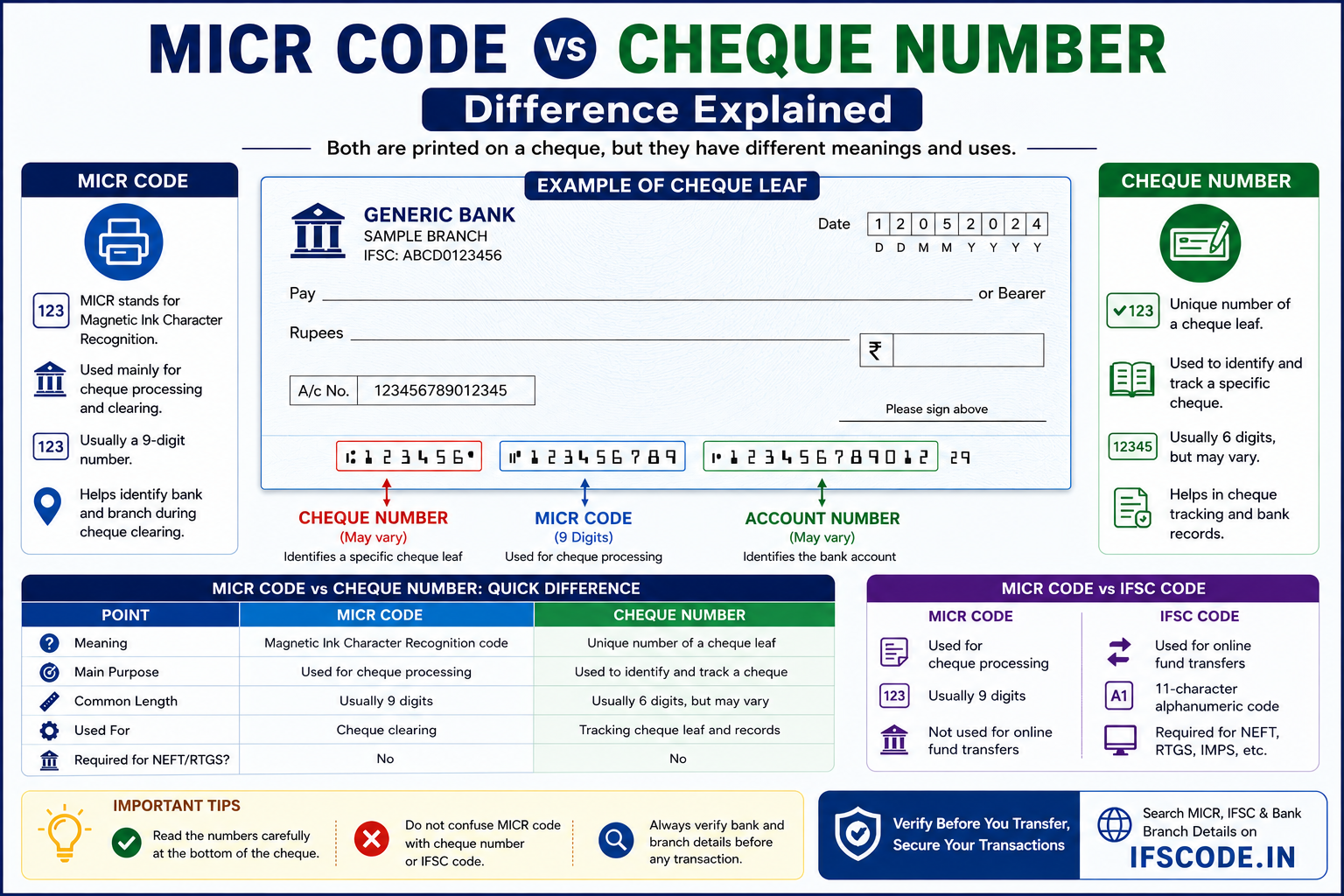
A cheque leaf contains different numbers, and many users get confused between MICR code and cheque number. Both may appear near the bottom of a cheque, but they are not the same.
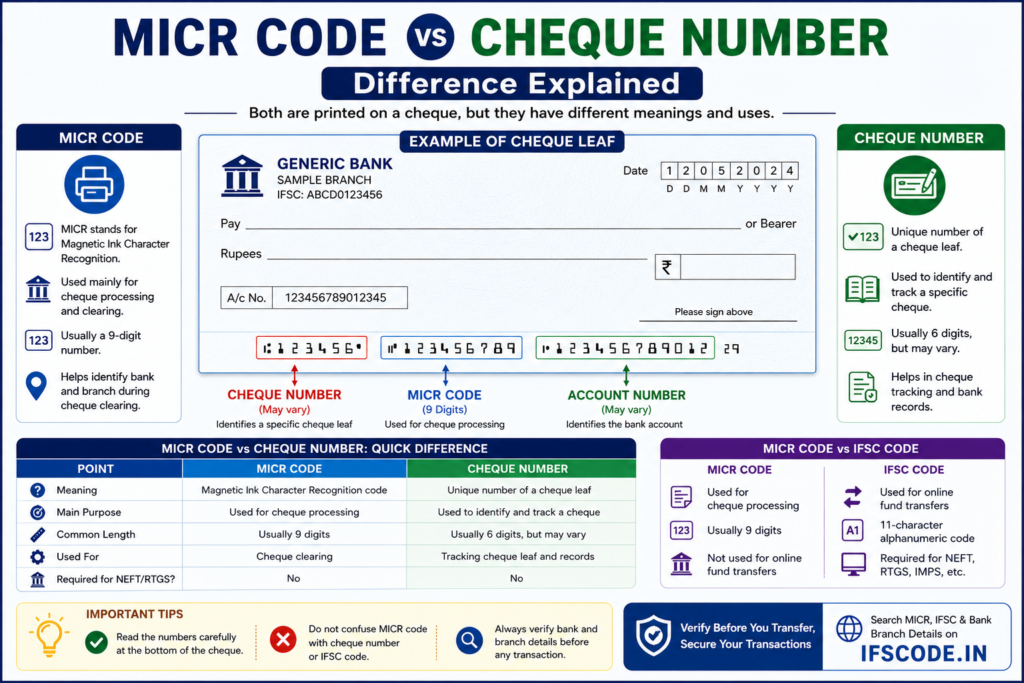
In this guide, you will learn the difference between MICR code and cheque number, where both are printed on a cheque and how they are used in banking.
Enter a 9-digit MICR code to find matching bank branch details. Blank or unavailable MICR records are ignored.
Table of Contents
- What is MICR Code?
- What is Cheque Number?
- MICR Code vs Cheque Number: Quick Difference
- Where Are They Printed on a Cheque?
- How to Identify MICR Code
- How to Identify Cheque Number
- Why Users Confuse MICR Code and Cheque Number
- MICR Code vs IFSC Code
- Common Mistakes to Avoid
- FAQs
- Final Words
What is MICR Code?
MICR stands for Magnetic Ink Character Recognition. MICR code is a number used mainly for cheque processing and cheque clearing.
It helps banks identify branch-related cheque information during the cheque clearing process. MICR code is usually printed at the bottom of a cheque leaf in a special font.
A MICR code is usually a 9-digit number.
What is Cheque Number?
A cheque number is a unique number printed on a cheque leaf. It helps identify and track a particular cheque from a cheque book.
Each cheque leaf in a cheque book usually has a different cheque number. This number is useful for cheque tracking, cheque records and bank reference.
MICR Code vs Cheque Number: Quick Difference
MICR code and cheque number are different. MICR code is related to cheque processing and branch identification, while cheque number identifies a specific cheque leaf.
| Point | MICR Code | Cheque Number |
|---|---|---|
| Meaning | Magnetic Ink Character Recognition code | Unique number of a cheque leaf |
| Main purpose | Used for cheque processing | Used to identify and track a cheque |
| Common length | Usually 9 digits | Usually 6 digits, but may vary |
| Printed location | Bottom line of cheque | Usually printed on cheque and bottom line |
| Used for online transfer? | No, usually not required | No, not required for online transfer |
Where Are They Printed on a Cheque?
Both MICR code and cheque number are usually printed on the cheque leaf. The bottom line of a cheque may contain multiple number groups, including cheque number, MICR code and account-related numbers.
- Cheque number is usually printed on the cheque leaf and also appears in the bottom number line.
- MICR code is usually printed in the bottom number line of the cheque.
- Account-related numbers may also appear near the same line.
- The exact placement may differ based on bank cheque design.
How to Identify MICR Code
MICR code is usually a 9-digit number printed at the bottom of the cheque. It is printed in a special font used for cheque processing.
When checking the bottom line of a cheque, look for the 9-digit number group. This is usually the MICR code.
- Check the bottom strip of the cheque.
- Look for a 9-digit number group.
- Do not confuse it with cheque number.
- Verify branch details if the cheque is old or unclear.
How to Identify Cheque Number
The cheque number is used to identify a particular cheque leaf. It is usually printed on the cheque and may also appear in the bottom number line.
Cheque number is commonly used when tracking cheque payments, recording cheque details or contacting the bank about a specific cheque.
- Check the cheque leaf for a separate cheque number.
- It may also appear in the bottom printed number line.
- It identifies the cheque leaf, not the bank branch.
- Do not use cheque number as MICR code.
Why Users Confuse MICR Code and Cheque Number
Users often confuse MICR code and cheque number because both can appear near the bottom of a cheque. They may also be printed close to account-related numbers.
The easiest way to avoid confusion is to remember their purpose. MICR code is mainly used for cheque processing, while cheque number identifies a specific cheque leaf.
MICR Code vs IFSC Code
MICR code is also different from IFSC code. MICR code is mainly used for cheque processing, while IFSC code is used for electronic fund transfers.
| Point | MICR Code | IFSC Code |
|---|---|---|
| Main use | Cheque processing | Online money transfer |
| Format | Usually 9 digits | 11-character alpha-numeric code |
| Used for | Cheque clearing | NEFT, RTGS and bank transfer |
| Printed on cheque? | Usually yes | Often printed on cheque leaves |
If you are sending money online, you usually need IFSC code and account number. MICR code and cheque number are not normally required for NEFT or RTGS transfer.
Common Mistakes to Avoid
While checking cheque details, avoid these common mistakes:
- Using cheque number as MICR code.
- Confusing MICR code with IFSC code.
- Using unclear numbers from an old or damaged cheque.
- Assuming MICR code is needed for every online transfer.
- Ignoring bank and branch details while verifying cheque information.
- Sharing cheque details publicly or with unknown people.
FAQs About MICR Code vs Cheque Number
Is MICR code the same as cheque number?
No. MICR code and cheque number are different. MICR code is used mainly for cheque processing, while cheque number identifies a specific cheque leaf.
Where is cheque number printed?
Cheque number is usually printed on the cheque leaf and may also appear in the bottom number line of the cheque.
How many digits are in MICR code?
A MICR code is usually a 9-digit number.
Is cheque number used for online transfer?
No. Cheque number is not used for NEFT, RTGS or IMPS transfer. Online transfers usually require account number and IFSC code.
Can I find branch details from MICR code?
If MICR data is available, you may be able to find bank and branch details using a MICR code lookup tool.
Final Words
MICR code and cheque number are different details printed on a cheque. MICR code is mainly used for cheque processing, while cheque number identifies a specific cheque leaf.
If you are checking cheque details, read the number groups carefully and do not confuse MICR code with cheque number or IFSC code. For online money transfers, always verify IFSC code, account number and beneficiary details before making any transaction.
Disclaimer: IFSCODE.IN is an independent informational platform. Users should verify important banking details directly with the respective bank before making any transaction.