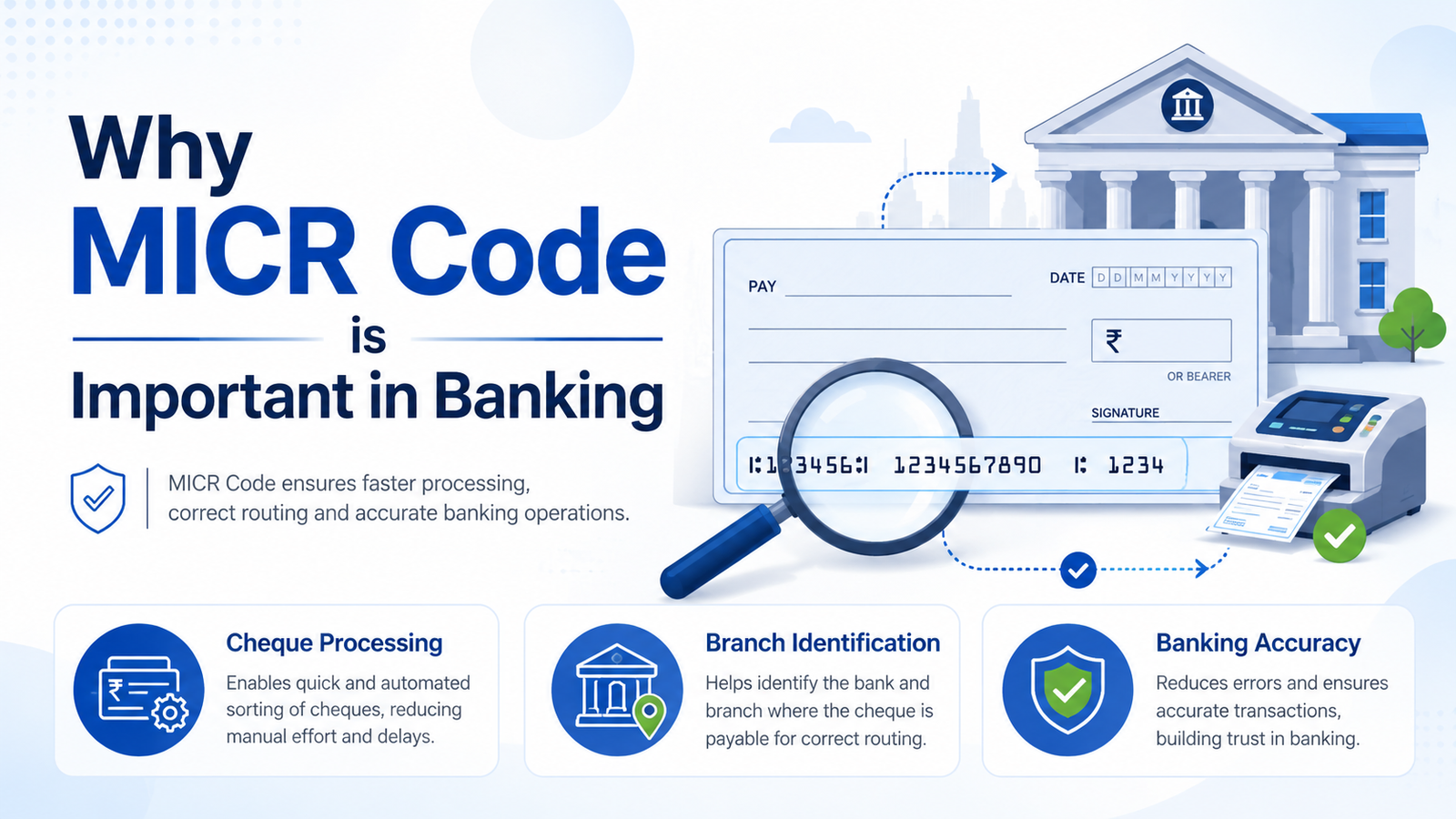
MICR code is an important banking code printed on cheque leaves. Many users see MICR code on a cheque but do not understand why it is used and how it helps banks process cheques.
In this guide, you will learn why MICR code is important in banking, how it supports cheque processing and how it differs from IFSC code.
Enter a 9-digit MICR code to find matching bank branch details. Blank or unavailable MICR records are ignored.
Table of Contents
- What is MICR Code?
- Why MICR Code is Important in Banking?
- How MICR Code Helps in Cheque Processing
- Where is MICR Code Printed?
- MICR Code Format
- MICR Code vs IFSC Code
- When Users May Need MICR Code
- Why Users Should Verify MICR Code
- Common Mistakes to Avoid
- FAQs
- Final Words
What is MICR Code?
MICR stands for Magnetic Ink Character Recognition. It is a code printed on cheque leaves and is mainly used for cheque processing and cheque clearing.
MICR code is usually a 9-digit number. It helps banks read cheque-related information quickly and accurately during the cheque clearing process.
You can usually find MICR code at the bottom of a cheque leaf along with cheque number and account-related numbers.
Why MICR Code is Important in Banking?
MICR code is important because it helps banks process cheques in a faster and more reliable way. It supports cheque clearing by allowing banking systems to identify cheque-related branch information.
Before digital payments became common, cheques were one of the most widely used banking instruments. Even today, cheques are used for many payments, records and financial transactions. MICR code helps make cheque processing more systematic.
- It supports cheque processing.
- It helps identify cheque-related bank branch details.
- It reduces manual reading errors.
- It helps banks handle cheque clearing more efficiently.
- It is useful for cheque-based banking records.
How MICR Code Helps in Cheque Processing
When a cheque is processed, banks need to read different details printed on the cheque. MICR code helps banking systems read cheque information using a special printed format.
This makes cheque processing more accurate compared to reading every detail manually. MICR code helps banks identify important cheque information and route the cheque through the clearing process.
In simple words, MICR code helps banks handle cheque clearing in a structured and machine-readable way.
Where is MICR Code Printed?
MICR code is usually printed at the bottom of a cheque leaf. It appears in the line where cheque number, MICR code and account-related numbers are printed.
The exact placement may differ depending on the cheque design, but users can generally find MICR code in the bottom number line of the cheque.
- Check the bottom strip of the cheque.
- Look for cheque-related number groups.
- MICR code is usually a 9-digit number.
- Do not confuse it with cheque number.
MICR Code Format
A MICR code usually has 9 digits. These digits help identify cheque clearing and branch-related information.
123456789
This is only a sample format. Do not use sample MICR codes for real banking verification. Always check the actual cheque leaf or verified bank branch details.
MICR Code vs IFSC Code
MICR code and IFSC code are different banking codes. Many users confuse them because both may be printed on cheque leaves, but their main purpose is different.
| Point | MICR Code | IFSC Code |
|---|---|---|
| Main use | Cheque processing | Online fund transfers |
| Common format | Usually 9 digits | 11-character alpha-numeric code |
| Used for | Cheque clearing | NEFT, RTGS and bank transfers |
| Printed on cheque? | Usually yes | Often printed on cheque leaves |
| Needed for online transfer? | Usually not required | Usually required |
If you are making an online money transfer, you usually need IFSC code and beneficiary account details. MICR code is mainly useful for cheque-related banking processes.
When Users May Need MICR Code
Most users do not need MICR code for regular online transfers. However, MICR code can be useful in cheque-related situations and bank branch verification.
- When checking cheque details.
- When verifying cheque-related branch information.
- When understanding cheque clearing details.
- When comparing MICR code with IFSC code.
- When searching bank branch details where MICR data is available.
You can use IFSCODE.IN to search MICR code, IFSC code and bank branch details across India.
Why Users Should Verify MICR Code
Users should verify MICR code because cheque details may be unclear, old or difficult to read. A damaged cheque leaf may also make it hard to identify the correct number group.
If you are checking MICR code, also verify the bank name, branch name and branch address. This helps avoid confusion between MICR code, cheque number and IFSC code.
For online fund transfers, always verify IFSC code and account number separately. Do not use MICR code in place of IFSC code.
Common Mistakes to Avoid
While reading MICR code or cheque details, avoid these common mistakes:
- Confusing MICR code with cheque number.
- Confusing MICR code with IFSC code.
- Using MICR code for online transfer instead of IFSC code.
- Reading numbers from a damaged cheque without verification.
- Sharing cheque details publicly.
- Ignoring bank and branch detail mismatch.
FAQs About Importance of MICR Code in Banking
Why is MICR code important?
MICR code is important because it helps banks process cheques accurately and supports cheque clearing by identifying cheque-related branch details.
Is MICR code used for online transfer?
Usually, MICR code is not used for online money transfers. IFSC code and beneficiary account details are commonly required for online transfers.
Where can I find MICR code?
MICR code is usually printed at the bottom of a cheque leaf along with cheque-related number groups.
Is MICR code the same as IFSC code?
No. MICR code and IFSC code are different. MICR code is mainly used for cheque processing, while IFSC code is used for electronic fund transfers.
How many digits are in MICR code?
MICR code usually has 9 digits.
Final Words
MICR code is important in banking because it helps banks process cheques and identify cheque-related branch details. It plays an important role in cheque clearing and cheque processing systems.
However, MICR code should not be confused with IFSC code. For online transfers, IFSC code and account details are commonly required. For cheque-related details, MICR code may be useful.
Disclaimer: IFSCODE.IN is an independent informational platform. Users should verify important banking details directly with the respective bank before making any transaction.